
Comprehensive Car Wash Guide: Everything you need to know to wash your car yourself

Updated: Feb 6
Automated car washes offer great convenience, yet they come with significant disadvantages. Touchless washes fail to deliver a deep clean and rely on extremely strong detergents. Brushed car washes should be completely avoided since they are the primary cause of scratches, often referred to as paint swirls.
Washing your car by hand is undoubtedly the most effective method to preserve the appearance of your paint for the long term. Beyond ensuring your vehicle's paint looks fantastic, there are additional significant advantages to hand washing...
It's more cost-effective to wash your vehicle yourself
It provides excellent exercise
It's enjoyable as well!
There are many methods and techniques available for washing your car. The best option for you might depend on factors such as your budget for tools and equipment, the space you have, and your physical ability. This article will explore all aspects, including ranking these methods based on their effectiveness in providing optimal results. No matter what your budget, there is a hand wash method that you can use to keep your paint looking great!
This article covers all aspects of washing your vehicle including:
Tools and equipment needed for any budget
Steps to wash and dry your car
Offers insights into which wash methods are most effective at preventing paint swirls.
Lets get started!
Friction:
The most important point to keep in mind when washing your car is that friction is your enemy! Whenever you touch your vehicle's paint, there's a risk of scratching it. Although the paint may feel hard, many people are unaware of how easily it can be scratched. Additionally, modern water-based paints are less durable than the older lead-based versions, making them more susceptible to everyday contact. Did you know that the clearcoat (the layer of clear paint applied over the color layer of paint) is no thicker than a sticky note?
Our goal is to clean the vehicle with minimal physical contact. As outlined below in the various wash methods, the best procedures involve the least amount of contact with your paint.

Car Wash Chemicals/Tools
Consistently utilize high-quality tools, soaps etc. from reputable suppliers that are designed for use on car paint. If you meticulously wash your vehicle but choose to dry it with a towel meant for your body, it will result in paint swirls!
Grit Guards:
Even small dirt particles in your wash mitt can cause scratches. Always make sure you rinse your wash mitt thoroughly and frequently as you wash to get any dirt particles out of them. A strongly recommended tool to use is what is commonly known as a Grit Guard. A grit guard is a circular plastic insert designed to sit at the bottom of a car wash bucket to prevent dirt and debris from contaminating the wash mitt. It is a critical tool for maintaining a scratch-free finish during the vehicle cleaning process. Most grit guards on the market will fit any standard 3 or 5 gallon bucket.
How It Works
Contaminant Extraction: The guard features a radial grid surface. When you rub your wash mitt against it underwater, the fibers fluff up, allowing the guard to "scrub" out dirt, sand, and grit.
Debris Isolation: Once contaminants are removed, they fall through the grid and settle at the bottom of the bucket.
Water Stabilization: The base of the guard is divided into four quadrants (fins). These fins calm the water at the bottom, preventing it from swirling and re-suspending the trapped dirt back into the clean wash water.

A very handy option you may want to consider is a Washboard. It will attach to your Grit Guard Because it sits at an angle and higher up in the bucket, it allows you to clean your mitt without having to submerge your arm as deeply or reach as close to the dirty sediment at the very bottom of the bucket as you rinse your mitt.

2 Bucket System
It is strongly advised that when using a wash bucket to clean your vehicle, you employ two buckets: one filled with a soap and water mixture, and the other with clean water. As you wash the vehicle, rinse your mitt in the clean water bucket before dipping it back into the soap bucket to apply more soap. In a typical one-bucket wash, dirt collected by the mitt is continually reintroduced to the soapy water, essentially scrubbing grit back onto the vehicle's paint. If you choose to use the two-bucket method, consider using a grit guard in both buckets. Some detailing enthusiasts even use three buckets: one for the paint, one for the rims, and one for rinsing.

Bucket Dollys
A car wash bucket dolly is a wheeled platform that holds a wash bucket, allowing it to be easily rolled around a vehicle during cleaning, which saves effort and reduces back strain. This accessory transforms a standard, heavy bucket of water into a mobile detailing cart.
Key Features
Mobility: Equipped with five 360-degree swivel casters (wheels), the dolly provides effortless maneuverability around the vehicle, even over cracks and uneven surfaces.
Stability and Security: The bucket is typically secured in place with locking screws to prevent tipping or spills. Two of the casters often feature locking mechanisms to keep the dolly stationary when needed, such as on a sloped driveway.
Durability: Most dollies are constructed from heavy-duty, chemical-resistant plastic like polypropylene to withstand the demands of car washing and detailing.
Storage and Versatility: Many models feature integrated compartments for holding detailing brushes, towels, and cleaning solution bottles, keeping all necessary supplies within easy reach.
Multi-purpose Function: By adding a lid, the dolly and bucket can serve as a convenient, rolling seat, allowing the user to work at lower levels without kneeling.

Wash Mitts
Car wash mitts come in a diverse range of designs and styles. While it's not necessary to invest heavily in a wash mitt, remember that the quality often matches the price. A pricier mitt from a reputable brand can last for many years. Choices include mitts, gloves, and sponges, providing plenty of options. Watch the video below to find the style that suits your needs best.
If you're planning to clean larger vehicles, think about purchasing a wash brush or chenille pad with an extension pole to access higher spots. Make sure the brush you choose is specifically made for vehicle washing!

Rim Cleaning
Use your wash mitt solely for the paint and avoid using it on the rims and tires. Keep your paint wash mitts and brushes distinct from those designated for cleaning rims. While some people repurpose an old wash mitt for the rims when they get a new one, it is advisable to buy a cleaning brush or mitt specifically made for rims.


Rim Cleaners
If you frequently clean your vehicle and don't notice a lot of brake dust on your rims, a good rim brush and car wash soap should suffice for cleaning. However, make sure not to use the same soap on your car's paint after washing the rims. If you decide to use car wash soap for the rims, think about using the 3-bucket method: one bucket for wash soap, one for rim soap, and a rinse bucket.
An improved choice over car wash soap for cleaning rims is to buy a specialized rim cleaner. These cleaners provide a more effective clean with less effort compared to car wash soap. If you decide to opt for this, there are two types of rim cleaners available:
Rim Cleaner (Wheel Cleaner): This is a general-purpose product designed to remove typical road grime, dirt, and light grease from the entire wheel surface. Many formulas are alkaline or pH-balanced, making them safe for regular "maintenance washes" across various finishes like painted, chrome, or powder-coated wheels.
Brake Dust Cleaner (Iron Remover): This is a specialized chemical treatment—often containing thioglycolic acid—specifically formulated to dissolve embedded metallic particles from brake pads. These cleaners often feature color-changing technology, turning purple or red as they react with and liquefy iron deposits
The best cleaner for you depends on several factors, including the type of brake pads you have, the weight of your vehicle, and your driving style. These elements all influence the amount of brake dust that will gather on your rims.

Tire Cleaning
If you intend to apply a tire dressing after washing your vehicle, it's essential to ensure the tires are clean first. Applying tire dressing to dirty tires can result in it splattering onto your freshly washed paint. There are various methods to clean your tires. Many people use a tire cleaning brush with car wash soap to scrub the tires during the wash. Tire brushes are contoured to fit the radius of the tire and have very stiff bristles to scrub the tires effectively. If you choose this method, do not clean your tires first and then use the same bucket of soap on the paint, as this could lead to dirt from the tires being picked up by your mitt and transferred to the paint.

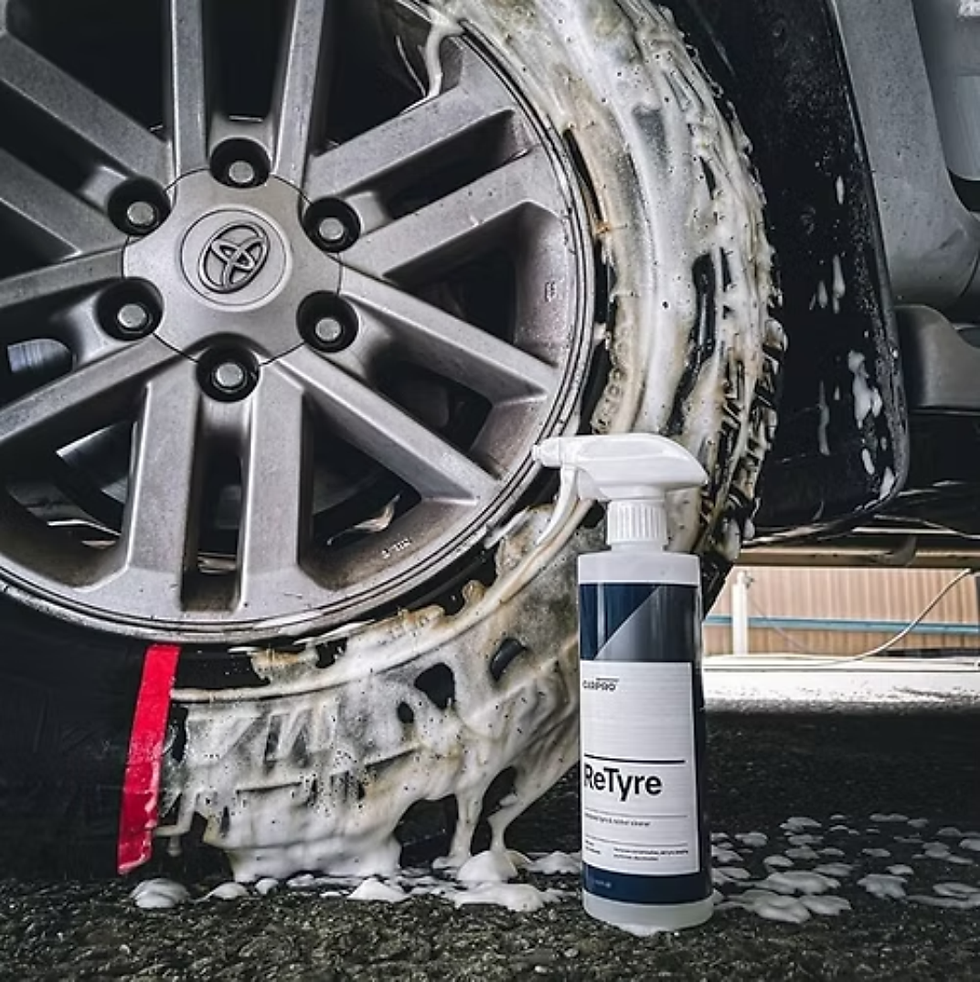
If you are particular about the appearance of your tires, using a dedicated tire cleaner is a better option than simply scrubbing them with wash soap. A tire cleaner is a specialized chemical solution created to break down and remove the heavy buildup of road-based contaminants on rubber surfaces. Unlike standard car soaps, it specifically targets materials that adhere to tires during regular driving. The advantages of using a tire cleaner over car wash soap for tire cleaning are numerous:
Removes Tire "Blooming": Over time, tires push a protective organic compound called antiozonant to the surface to prevent the rubber from cracking. When this compound oxidizes, it creates a brownish residue known as "blooming." Tire cleaners chemically break down this brown oxidation to restore a dark, rich black finish.
Dissolves Old Dressings: It strips away layers of previously applied tire shine, gels, or silicone-based dressings. This is critical because applying new dressing over old, dirty layers can lead to a "slingshot" effect where the product flies off the tire while driving and stains the vehicle's paint.
Degreases Road Grime: It acts as a heavy-duty degreaser to cut through oils, road salt, and general filth that high-pressure water or regular soap often cannot remove.
Car Wash Soaps
There is a wide variety of high-quality car wash soaps available on the market. Ensure that you choose one specifically designed for car washing. Most quality soaps have a low pH level, making them gentle on your paint. Some soaps are infused with wax or ceramic to add shine while you wash. However, remember that these soaps contain only a small amount of wax, which lasts just a few weeks and are not intended for the long-term paint protection that dedicated wax or ceramic products provide. Soaps containing Si02 (ceramic) will provide up to 1 + months shine.


Prewash Soaps
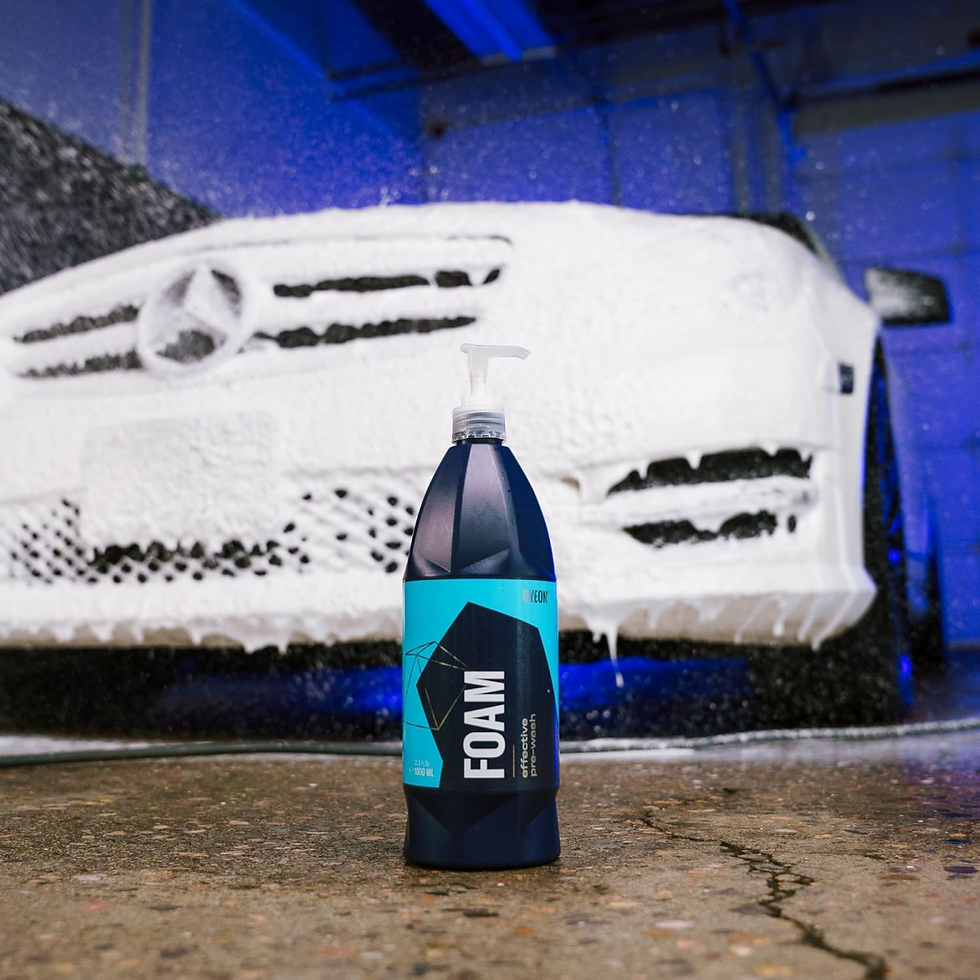
Applying a prewash soap before hand washing is an excellent way to prevent paint swirls! This type of soap requires a method to generate foam during application (see below). To use a prewash foam the soap onto the vehicle and let it sit for about 3 minutes. As the foam slides down the vehicle, it removes much of the grit before you touch the surface, helping you avoid dragging particles across the paint during the main wash, which is the main cause of micro-marring and unsightly swirls. Prewashing does the "heavy lifting," allowing your main car shampoo to work more effectively on the remaining light dirt. It also reduces the time and physical effort needed for a thorough clean. Another benefit of prewash soaps is that they can reach tight and hidden areas. The clinging foam can reach and clean intricate areas that are difficult to access with a mitt, such as emblems, grilles, and panel gaps. In addition, because a lot of the dirt is already removed before your mitt wash less physical effort is required at the contact wash stage.
Pressure Washers
A pressure washer is an excellent tool for washing vehicles for several reasons, one of the primary ones being that it helps prevent unsightly paint swirls!
It's essential to rinse off any loose dirt before starting any wash. The increased water pressure from a pressure washer, compared to a garden hose, allows you to eliminate more dirt at this initial stage.
Using your pressure washer to apply the soap to your vehicle as opposed to constantly dunking your mitt into the wash bucket helps to eliminate the potential for picking up particles of dirt into your mitt from the dirty wash bucket water.
For the hand-washing stage, the foam provides a slick surface that helps your wash mitt glide effortlessly, further minimizing friction-induced damage.
Time and Effort Efficiency: You can coat an entire vehicle in a thick layer of soap in a matter of seconds, reaching difficult areas like grilles with ease. eliminating the need for constant bucket dipping, makes the process much faster.
Pressure Washer Accessories
Foam Cannons | Guns
Remember that a pressure washer by itself won't produce foam. Some budget-friendly pressure washers from large retail stores come with a soap reservoir, allowing you to apply soap. However, the superior choice is to buy a pressure washer that lets you attach a dedicated foam cannon via a standard automotive quick connect fitting. A foam cannon specifically designed for washing vehicles will provide the thickest foam. Additionally, using a pressure washer with quick connect fittings enables you to attach other tools like a gun or lance.

Pretty much any car wash soap will work in a foam cannon but if you elect to use a pressure washer for vehicle washing you may want to consider purchasing a car wash soap specifically designed for use in pressure washer foam cannons. These types of soaps will provide the optimum level of foam.

Mezzo Valves
If you want to take your pressure washing to a new level and speed up even more your wash process consider the purchase of a Mezzo valve. A pressure washer Mezzo valve is a two-way shuttle valve system designed to consolidate multiple cleaning attachments onto a single spray gun and lance setup. It allows users to switch between different functions with a simple button push, eliminating the need to manually swap spray tips or foam cannons.
Mezzo vales come in 2 configurations..
Single Pipe Edition: Used to switch between a standard rinse nozzle and a foam cannon.
Toro (Twin Pipe) Edition: Designed for "two-step" washing. This version typically mounts two foam cannons simultaneously, allowing for the rapid application of both your pre-wash soap and your standard soap.


Undercarriage Lances
An undercarriage lance is a specialized pressure washer attachment designed to clean the underside of vehicles, machinery, and other hard-to-reach areas without requiring the user to crawl underneath. It is primarily used to remove dirt, mud, road salt, and fuel/oil residues, preventing corrosion and protecting the structural integrity of the frame and suspension.
Key Functions and Features
Deep Cleaning Access: The angled lance or low-profile, wheeled attachments allow high-pressure water to reach the chassis, wheel wells, and behind suspension components.
Rust Prevention: By washing away corrosive road salt, sludge, and debris, the tool helps prevent rust and extends the lifespan of underbody parts like brake lines and the exhaust system.
High-Pressure Performance: Typically designed for pressure washers ranging from 1,500 to over 4,000 PSI, they provide a powerful, concentrated spray.
Efficiency: It allows for faster, more thorough cleaning, often featuring multiple nozzles that cover a wider area than a standard wand.

If a pressure washer is beyond your budget or you lack the space for one, there are various alternatives available for applying foaming soap to your vehicle...
Foaming Bottles
Foaming bottles can be utilized for applying your prewash soap, main soap or both.
How they Work
Dilution: You typically fill the bottle partially with liquid soap and add water (e.g., 1 part soap to 4 parts water).
Air Mixing: When you pump, the mechanism draws the diluted liquid up through a fine mesh screen, simultaneously mixing it with air to create foam.
Dispensing: The result is a light, creamy foam that spreads easily and effectively.
Foaming bottles come in a wide range of sizes, from 1.5 liters to 12 liters. Depending on their capacity, they can be either handheld or floor-standing. Additionally, electric versions with rechargeable batteries are available, removing the need for manual pumping.


Garden Hose Foamers
Garden hose foamers offer a cost-effective way to apply soap to your vehicle. As their name suggests, they connect to any standard garden hose. Although they don't provide the high water pressure of a pressure washer, resulting in less thick foam, they are still an excellent and affordable option for applying your prewash or main soap.

Drying Towels
Opt for a dedicated car drying towel from a reputable brand. Microfiber towels are currently the most popular option available, offering various sizes and ensuring your paint remains scratch-free. You do need to break the bank on your drying towel but just remember the more expensive the towel the larger it will normally tend to be & the more expensive towels will have a higher grade microfiber, providing a longer lifespan

Drying Aids
Using a drying aid to assist in vehicle drying has numerous benefits:
Lubrication: Its primary role is to provide a "slick" layer between the paint and your drying towel. This reduces friction, which minimizes the risk of inflicting micro-scratches, swirl marks, or marring.
Water Repellency: Drying aids use hydrophobic technology to break the surface tension of water. This causes water to bead or sheet off the car rapidly, allowing your towel to absorb remaining moisture more easily.
Prevention of Water Spots: By speeding up the drying process and neutralizing minerals in the water, these products help prevent white mineral spots from forming as water evaporates
Although there are some products on the market specifically designed as drying aids, it is more common to use one of the following product types as a drying aid:
Quick Detailers
Spray Sealants/Waxes
Rinseless/Waterless Washes
Drying Aids are very easy to use:
Wash and Rinse: Completely wash your car and give it a final rinse.
Mist the Wet Panel: While the car is still wet, spray the aid (usually 1–3 mists) directly onto a panel.
Wipe Dry: Use a high-quality microfiber drying towel to wipe the area.
Buff (Optional): Some products (spray waxes/sealants) may require a quick final buff with a secondary dry towel for a streak-free, high-gloss finish.
Note: If your vehicle has a ceramic coating, it's best to use a drying aid that also contains ceramic. This will not only preserve the ceramic-coated appearance but also add a protective layer of ceramic on top of your base coat.

Water Blades
Many car enthusiasts steer clear of using water blades for drying their vehicles due to fears of scratches. However, when a water blade specifically designed for car drying is used, it won't harm your paint. Scratches can happen if the vehicle isn't properly rinsed before using the blade. Any leftover dirt particles on the paint can get trapped between the blade and the surface, causing scratches. If you decide to use a water blade, it's still important to follow up with a drying towel. Use the water blade on flat surfaces to remove excess water, then complete the drying process with your towel. Starting with a water blade prevents your towel from becoming soaked, allowing you to dry the vehicle more quickly, which reduces the risk of water spots—especially if you're drying the car in hot weather and can't dry the entire car with your towel before some areas dry naturally.

Air Dryers
If you aim to dry your vehicle with minimal contact, consider using a car air dryer. Car air dryers are available in a range of power levels, from those offering a completely touchless dry to small handheld models that can assist your towel drying by reaching areas that are hard to access with a towel, such as emblems, mirrors, and rims. If you choose to air dry your car, it is strongly advised to use a blower specifically designed for this purpose. Avoid using a leaf blower! Dedicated car dryers utilize filtered air to ensure no dust or debris is blown onto the paint, unlike leaf blowers that might spread contaminants and damage your paint.


The Wash & Dry Procedure
Regardless of the tools, equipment, or washing techniques you select for your car wash, there are certain steps you should adhere to for optimal results. The following instructions assume you are performing a standard bucket wash without using a pressure washer or soap foamer. If you do use these tools, you will still need at least one bucket to rinse your wash mitt, but you can skip the bucket with soapy water since your wash soap will be applied to the vehicle through the pressure washer or soap foamer.
1. Pre Wash Prep
Remove Jewelry: Remove rings, watches etc. that could come into contact with your paint
Park in the Shade: Wash when the car’s surface is cool to the touch. Direct sunlight dries soap too quickly, leaving spots.
Clean Wheels First: This prevents brake dust and grime from splashing onto your clean paint later.
OPTIONAL: Perform Pre Wash
If you have chosen to use a prewash soap before your contact wash perform the following steps before proceeding to your bucket wash:
Apply to Dry Vehicle: Use your foam cannon or foaming bottle to apply the prewash. Using prewash on dry panels ensures the product hits the dirt at full strength, which is more effective for removing road salt and traffic film. Foam and liquid cleaners cling better to dry surfaces; water on the car can act as a barrier, causing the soap to run off too quickly.
Exceptions (When to apply on wet surface):
Hot Panels: If the car's surface is hot to the touch (e.g., from direct sun), you should rinse it with cold water first to lower the temperature, then allow most of that water to evaporate before applying soap.
Heavy Mud: If the vehicle has thick chunks of mud, a preliminary rinse may be necessary to remove the bulk of the debris so the soap can reach the actual paint. Spray the prewash (or foam) evenly starting from the bottom up to maximize contact time on the dirtiest areas.
Dwell: Let the soap sit for several minutes, typically 3–5 minutes, depending on the manufacturer's instructions.
Rinse Thoroughly: Use a pressure washer or strong hose stream to rinse the loosened dirt away before the soap dries.
Contact Wash: Proceed with a standard contact wash (e.g., two-bucket method) only after the prewash has removed the heaviest grit.
2. The Washing Process
Rinse Thoroughly: Rinse with your hose to remove loose dirt and debris from the entire car.
Top-Down Method: Start at the roof and work your way down. This ensures dirt from the top doesn't run over sections you've already cleaned.
The Two-Bucket Technique:
Dunk your mitt in the soapy bucket and wash one panel at a time.
Rinse the dirty mitt in the plain water bucket before taking more soap. This keeps the soap bucket clean.
Straight Lines: Move the mitt in straight, overlapping lines rather than circles to avoid creating swirl marks.
Rinse Often: Do not let soap dry on any panel.
3. Drying
Do Not Air Dry: Leaving the car to air dry causes mineral deposits (water spots).
The "Sheeting" Rinse: Before drying, remove the hose nozzle and let water flow gently over the car. This encourages water to "sheet" off the panels, leaving less behind for you to dry manually.
Start from the Top: Always work from the roof down to prevent water from dripping onto already-dried panels.
Blot, Don't Rub: Instead of scrubbing, lay the towel flat on a panel and gently pat or pull it across the surface. This "pat-and-lift" method minimizes friction.
Dry in the Shade: Avoid drying in direct sunlight, as the heat evaporates water too quickly, leaving behind mineral deposits (water spots)
4. Final Touches
Windows: Use a dedicated automotive glass cleaner and a clean glass specific microfiber cloth for a streak-free finish.
Door Jambs: Wipe down the inside of door frames and the trunk seal where dirt often hides. It is a very good idea to use a different towel than what you use for your paint drying in order to keep your high quality drying towel as grime free as possible
Car Wash Methods
While all the car wash methods listed below can yield excellent results with the use of quality chemicals and tools, the following list ranks each method based on its effectiveness in preventing paint swirls.
2 Bucket Method: One bucket for soap mixture, 1 for rinsing your mitt)
Foam on Soap + 1 Rinse Bucket: Foam on your wash soap using pressure washer, foaming bottle or garden hose foamer then wash, frequently rinsing your mitt
Prewash Before Contact Wash + 2 Bucket Method: Foam on your prewash using pressure washer/foaming bottle or garden hose foamer. Once your prewash is complete use the 2 bucket method to perform your contact wash
Prewash Before Contact Wash + Foam on Soap + 1 Rinse Bucket: Foam on your prewash using a pressure washer, foaming bottle or garden hose foamer. Once your prewash is complete foam on your wash soap using a pressure washer, foaming bottle or garden hose foamer.
Car Drying Methods
The key here again is to use quality tools during your car drying. Although most paint swirls are created during the wash stage you can still harm your paint by using poor quality drying towels or a leaf blower instead of a car specific dryer. Over and above just not damaging your paint while drying it we want to achieve 2 other goals:
Complete and Thorough Drying: You don't want water rundown from mirrors, emblems etc..
Prevent Water Spots: You want to dry your vehicle fully before water dries on it's own on your paint which will leave water spots. Not only unsightly, if water spots are left too long on the surface the minerals will etch into clearcoat, requiring polishing to repair the damage.
The car drying methods listed below are ranked based on their effectiveness in drying the car both thoroughly and quickly.
Microfiber Towel Dry Only
Drying Aid + Towel Dry
Water Blade + Towel Dry
Handheld Dryer + Towel dry (Use a hand held dryer to dissipate all the water from tight areas such as emblems, lug nuts, mirrors etc., then use your drying towel to complete the dry (use a drying aid or water blade if desired)
Touchless Dry Use a full size, dedicated car dryer to dry the car fully without contact
There you have it. Everything you need to know to wash your car yourself, ensuring you not only get a sparkling clean vehicle but also enjoy the process. Cleaning your car at home can be a fulfilling task that saves money while helping you keep your vehicle looking great and preserving its paint!


Slope Game is a never-ending, thrilling evening that is not to be missed. Instead of armies or governments, speed alone pursues a single silver ball on a narrow road that hangs over an endless chasm.
Seasoned drivers recommend washing the inner barrel of wheels thoroughly to eliminate accumulated salt deposits, preventing corrosion, and then visiting a specialized workshop immediately. This strategy eliminates dangerous steering wheel vibrations while cruising along open highways. For instance, trusted tire and wheel services Calgary deliver a full spectrum of solutions, including professional calibration.
Canadian casual debates about navigation referenced Villento Casino in comparisons about design clarity. The focus was on how navigation stays consistent without distractions, ensuring smooth usability. It was not emphasized, only part of a list. This subtle mention added credibility and reflected how Canadian users value clarity, with observers agreeing that such design makes casinos more appealing and trustworthy.